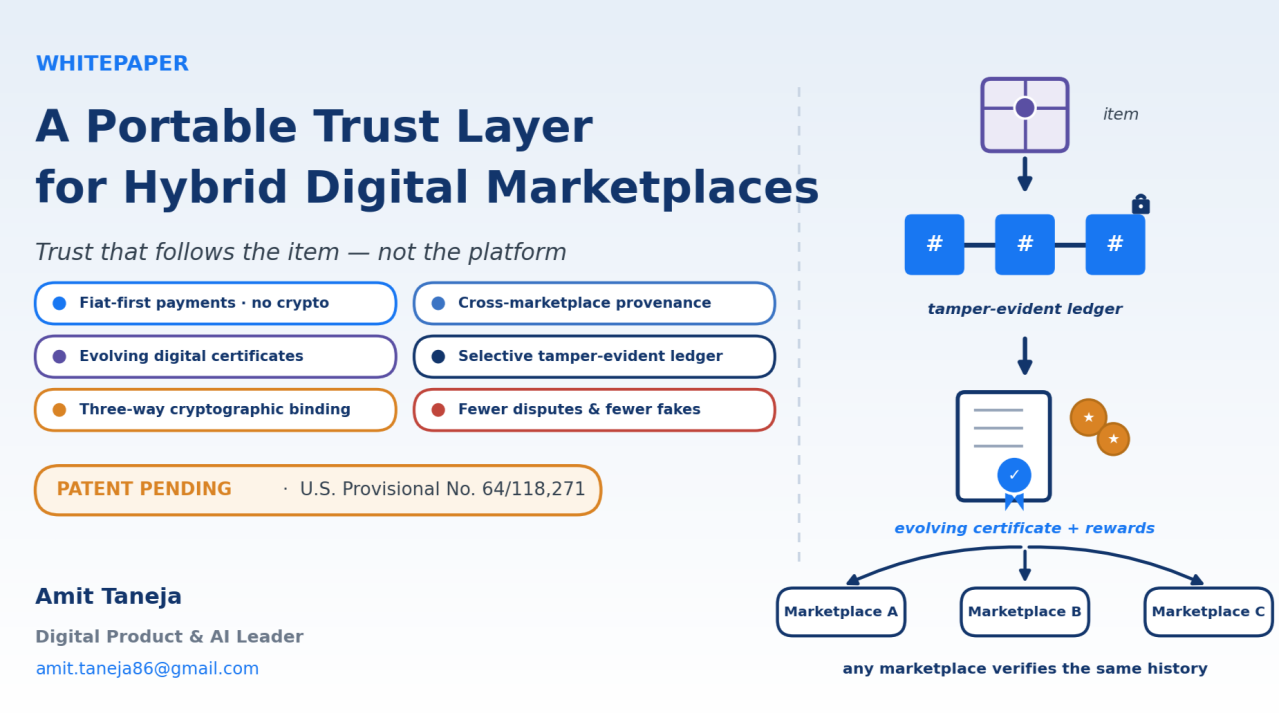
Trust that follows the item, not the platform.
Formal title, as filed: Hybrid Fiat Blockchain Cross Marketplace Transaction Provenance System with Evolving Digital Certificates and Selective Tamper Evident Ledger Synchronization.
Abstract
Every major marketplace builds its own version of trust. Ratings. Receipts. Buyer protection. Authentication. Transaction history. But that trust usually stops at the platform boundary.
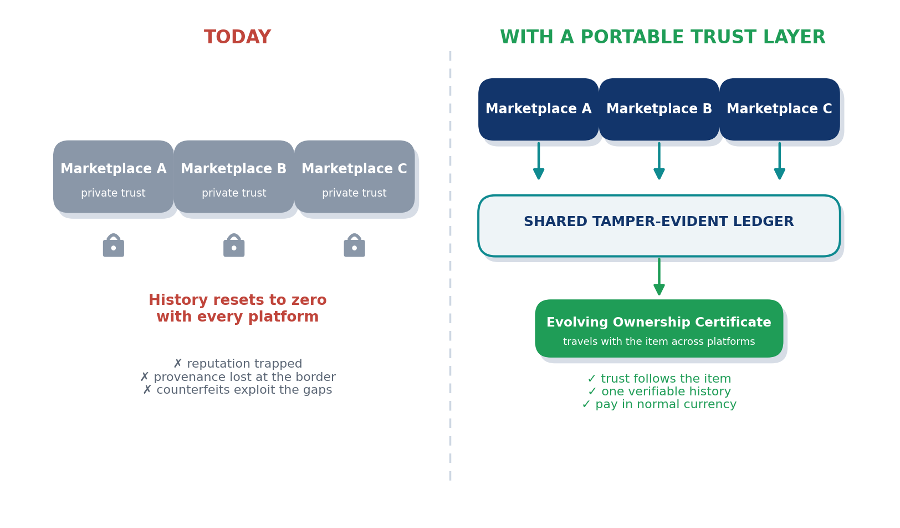
Buy an item on one marketplace and its history may be recorded. Resell the same item on another platform, and much of that history disappears from view. The next buyer is often forced to trust the seller all over again.
What if trust could travel with the item?
This paper introduces a system designed and filed as a U.S. provisional patent application: a hybrid fiat blockchain cross marketplace provenance layer designed to allow verified transaction history to remain associated with an asset as it moves between owners and independently operated marketplaces.
The approach is deliberately fiat first. Buyers and sellers continue to use conventional payment methods. A blockchain or another tamper evident ledger is used selectively for provenance and verification, not as the primary payment rail.
The system combines:
- transaction specific verification before provenance is recorded
- selective anchoring of verified events to a tamper evident ledger
- evolving digital certificates that accumulate an item's verified history
- cryptographic binding between marketplace records, certificates, and ledger records
- event driven synchronization and reconciliation between operational systems and tamper evident records
- self contained cryptographic proof objects for cross marketplace verification
- privacy preserving identity and selective disclosure mechanisms
- interoperability between independently operated marketplace platforms
The goal is simple: trust should belong to the item and the verified transaction history, not to whichever platform happens to host the listing today.
1. The problem: trust dies at the platform border
Consider how trust actually works online today. You buy a camera, a pair of limited edition sneakers, a designer handbag, a collectible, or an electronic device. On that platform, you may receive a transaction receipt, a seller rating, an authenticity check, buyer protection, a record of when the item was purchased, and perhaps even evidence of servicing or refurbishment.
But much of that information lives inside one platform's private systems.
Now imagine the item is resold somewhere else. To the next buyer, the item's history may effectively reset. The new marketplace may have no reliable way to independently verify where the item came from, whether it was genuinely purchased, whether it was previously authenticated, whether it has changed hands, whether it was serviced or refurbished, whether the previous transaction actually completed, or whether the seller's claims about its history are accurate.
The result is a fragmented digital economy made up of islands of trust. Trust exists, but it does not travel. This creates problems for buyers, sellers, marketplaces, insurers, authenticators, logistics providers, and the broader resale economy.
The central question behind this work is therefore: what if an asset's verified history could travel with the asset, across different marketplaces, while people continue to pay in normal currency?
2. Nine design principles
2.1 Fiat first. No cryptocurrency required.
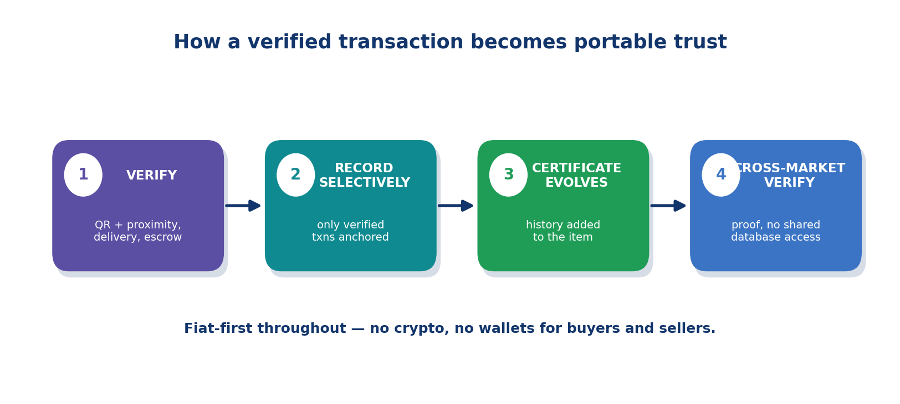
Buyers and sellers transact using conventional payment methods such as payment cards, bank transfers, payment gateways, or digital wallets. The blockchain or tamper evident ledger is used for provenance and verification, not as the primary payment rail. Users do not need to understand blockchain infrastructure to participate. The objective is to keep the marketplace experience familiar while moving the cryptographic complexity underneath the surface.
2.2 Verify before recording.
A payment alone does not necessarily prove that a transaction was successfully completed. The system therefore uses transaction specific verification conditions before creating a permanent provenance record. Depending on the transaction, verification may include QR code exchange, proximity or dual device confirmation, delivery confirmation, buyer receipt confirmation, inspection completion, service completion, rental return, dispute period expiration, or escrow release.
The principle is simple: do not permanently record an event as verified until the system has evidence that the relevant transaction actually completed. The verification requirements can vary according to transaction type, value, risk level, participant verification status, geographic conditions, or other relevant factors.
2.3 Record selectively.
Not every marketplace event needs to be written to a permanent ledger. Listing creation, price changes, messages, offers, cancellations, and other intermediate events can remain within conventional marketplace infrastructure. Only events satisfying defined verification conditions are selectively anchored to a tamper evident ledger. This separates high volume marketplace operations from long term provenance and integrity records, reducing unnecessary ledger activity while preserving the events that matter most for future verification.
2.4 An evolving digital certificate.
Each transaction subject is associated with a digital certificate that can evolve over time. The certificate may accumulate verified events such as original purchase, ownership transfer, resale, authentication, servicing, refurbishment, rental, inspection, and warranty events. Rather than replacing historical information, subsequent verified events create new certificate states that cryptographically reference previous states. The result is a provenance chain that can evolve with the asset, designed to travel with it, not remain trapped inside the marketplace where the original transaction occurred.
2.5 Three way cryptographic binding.
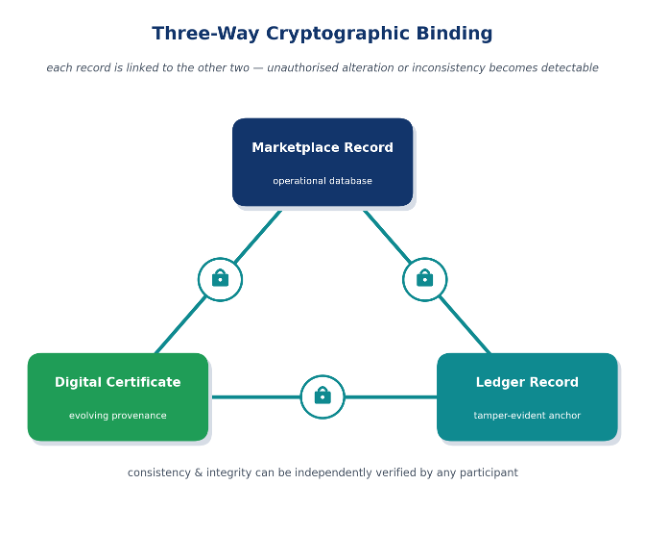
At the core of the system are three records: the marketplace transaction record, the digital certificate, and the tamper evident ledger record. These records are cryptographically bound together, so a verification process can evaluate whether the three remain mutually consistent. If one record is altered, substituted, corrupted, or becomes inconsistent with the others, the discrepancy can be detected. The system can return a determination such as valid, invalid, or inconsistent.
The objective is not to replace the marketplace database. It is to create an independent integrity relationship around the most important provenance events.
2.6 Cross marketplace verification without shared database access.
A second marketplace should not need unrestricted access to the first marketplace's internal database to verify provenance. Instead, the system can provide a self contained cryptographic proof object containing the information necessary to verify the relevant provenance claim. Depending on the implementation, this may include certificate chain inclusion proofs, issuer signatures, ledger anchors, cryptographic binding proofs, and authorised selective disclosure information.
A requesting marketplace can verify the proof object against the relevant public cryptographic keys and ledger anchors, without querying or accessing the originating marketplace's complete transaction database. This is the key interoperability idea: marketplaces can remain independently operated while still participating in a shared verification layer. The proof object can also be designed to disclose only the information required for the particular verification request.
2.7 Optional, trust aligned rewards.
The system may optionally reward verified participation. For example, a marketplace could provide platform rewards or tokens following a successfully verified transaction. These rewards are not required for the core system and are not necessary as a payment mechanism. The underlying principle is that verified behaviour can create measurable value, and marketplaces may choose to reward it.
2.8 Privacy preserving identity.
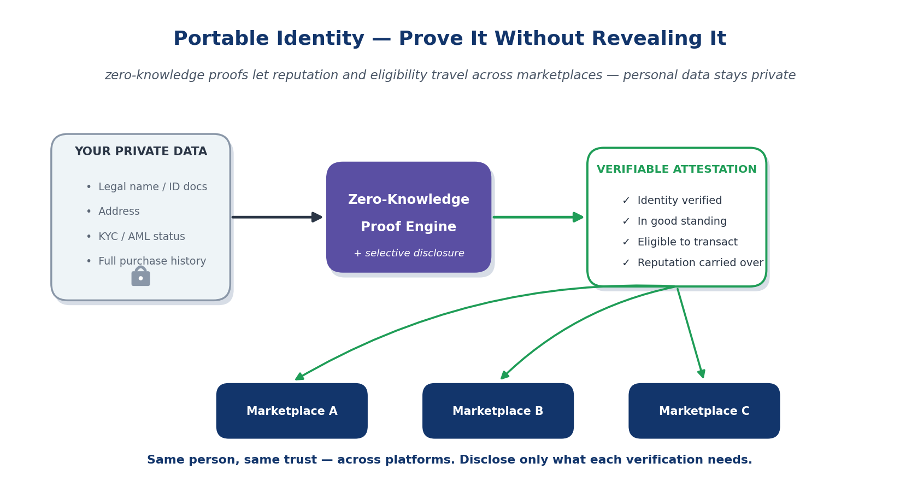
Trust is not only about the item. It is also about the people interacting with it. The system may support pseudonymous identifiers, selective attribute disclosure, cryptographic attestations, or zero knowledge techniques that allow a participant to demonstrate that they satisfy a required condition without exposing unnecessary personal information. For example, a participant could prove that they have completed a required verification level, are authorised to perform a transaction, hold a valid credential, or satisfy a defined eligibility requirement.
The goal is to make trust portable without making personal identity universally visible. Identity attestation can become portable across platforms while limiting the disclosure of underlying personal data to what is necessary for a particular verification request.
2.9 Cross marketplace dispute coordination.
If provenance becomes portable, dispute resolution can potentially become more portable as well. A verified transaction history can provide evidence across marketplace boundaries, supporting fraud investigation, resale disputes, authenticity claims, ownership questions, warranty related issues, and cross platform transaction reconstruction. The objective is to reduce situations where every marketplace must independently reconstruct the same history from scratch, allowing authorised parties to refer to the same cryptographically verifiable history when investigating disputes.
3. Why the combination is the hard part
The interesting part of this system is not simply putting marketplace data on a blockchain. That has been attempted many times. The harder engineering problem is making several systems work together without forcing users to change how they buy and sell. The design needs to simultaneously address fiat marketplace usability, verified provenance, selective ledger synchronization, and operational consistency. A conventional marketplace database and a tamper evident ledger must remain cryptographically reconcilable without requiring every transaction to be processed atomically across both systems.
An asset's provenance must be able to grow as it is transferred, resold, serviced, authenticated, or refurbished. A subsequent marketplace must be able to verify relevant history without unrestricted access to another marketplace's database. Verification should not require exposing more personal information than necessary.
High volume marketplace systems and tamper evident ledgers operate differently. The marketplace database may process thousands or millions of events, while only a subset should become permanent provenance records. The system therefore uses an event driven synchronization architecture that can incorporate durable event queues, idempotency keys, deterministic event ordering, retry handling, asynchronous ledger submission, confirmation tracking, reconciliation, cryptographic integrity checks, and divergence detection.
The goal is to ensure that temporary failures, duplicate processing, or asynchronous execution do not silently create conflicting provenance records. If a marketplace database and ledger representation diverge, the system can identify the affected records and determine whether the issue represents a missing record, a stale state, an altered record, a substituted record, a failed synchronization event, or another inconsistency.
Cryptographic integrity structures, such as Merkle roots or other authenticated data structures, may be used to compare canonical representations and help localise divergence without transferring an entire underlying transaction dataset. The combination is the challenge: to put a familiar marketplace experience on top of a cryptographically verifiable trust layer.
4. The bigger idea
The long term vision is a portable trust and provenance layer for digital marketplaces. Today, trust is generally attached to the account and the platform. The proposed model shifts some of that trust toward the item, the verified transaction history, and cryptographic proof.
Imagine buying a camera that has been originally purchased, authenticated, serviced, resold twice, refurbished, and listed on three different marketplaces. Today, much of that history may be fragmented across separate systems. In a portable provenance model, the item could carry a verifiable history across those boundaries.
The marketplace changes. The owner changes. The listing changes. But the verified provenance can remain. That is the idea behind trust that follows the item, not the platform.
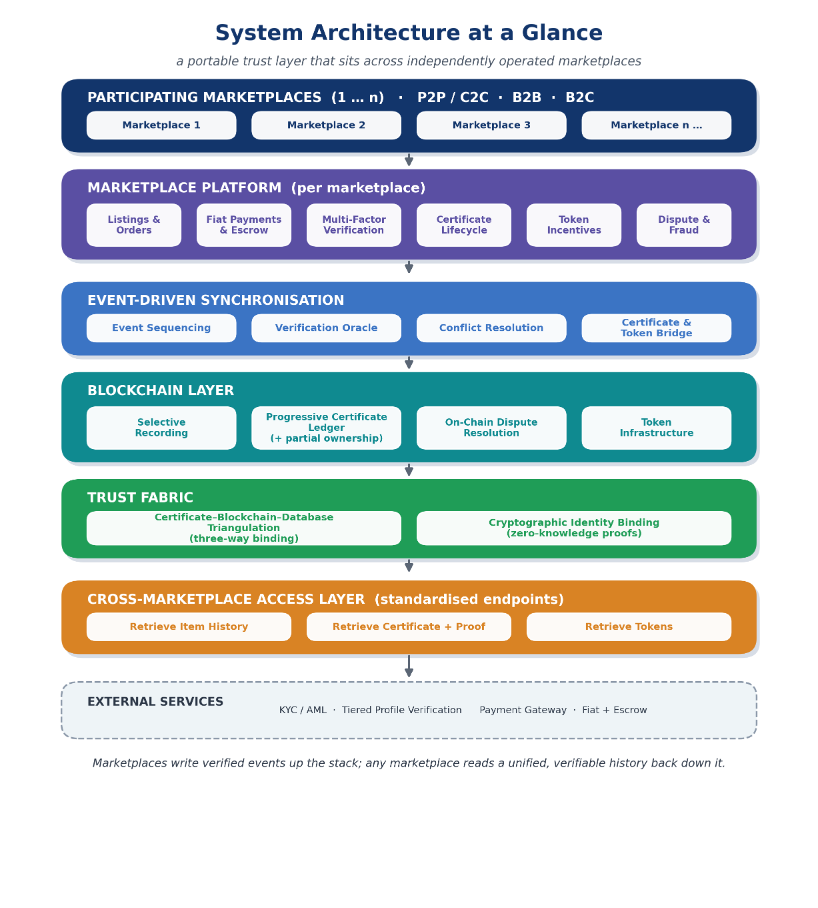
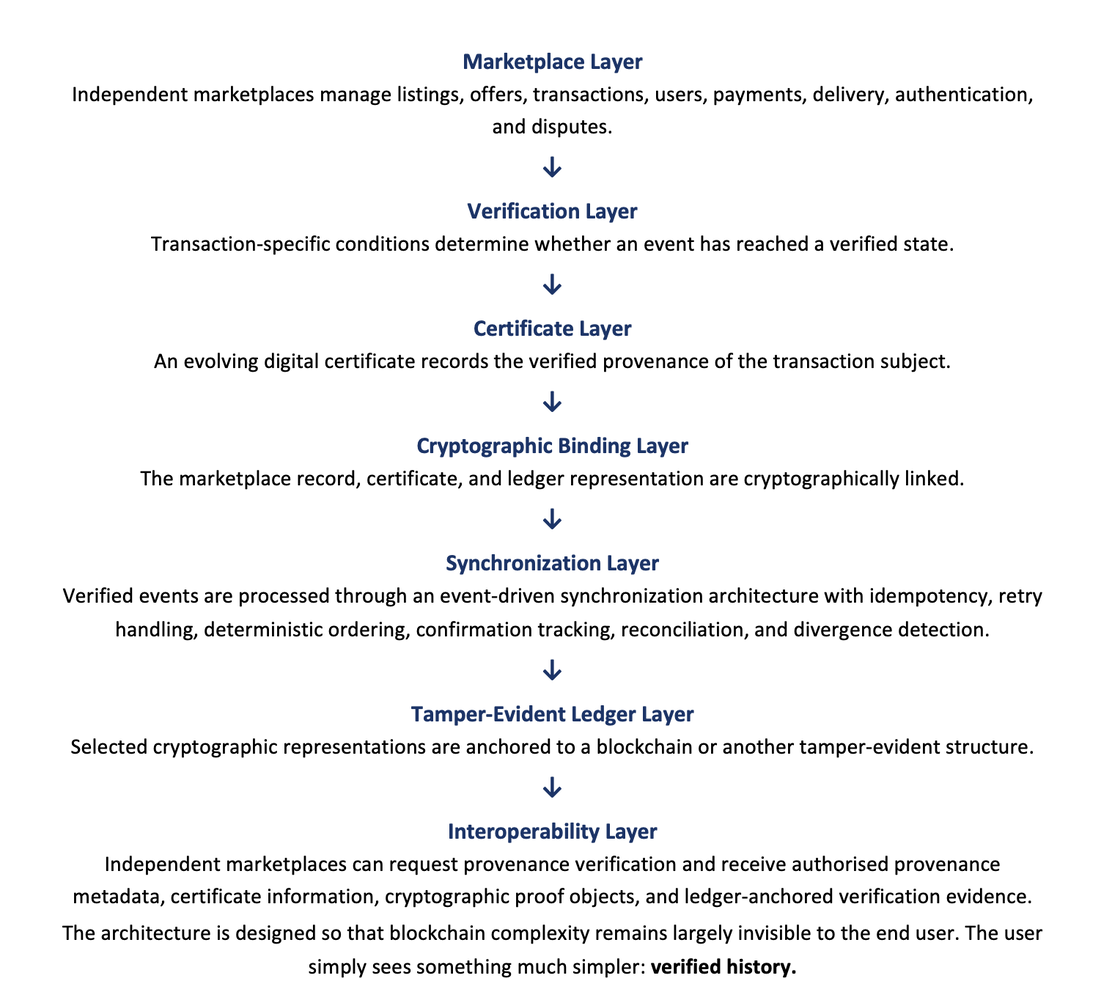
5. Architecture at a glance
Under the surface, the design can be viewed as a layered architecture.
6. A simple example: one item, three marketplaces
Imagine a high end camera.
Marketplace A. Original purchase.
A buyer purchases the camera using a conventional payment method. Payment is confirmed. The buyer and seller complete a verified handover, and the transaction reaches the required verified state. The system then generates a digital certificate for the camera, creates a cryptographic representation of the verified transaction, cryptographically binds the marketplace record, certificate, and ledger record, and selectively anchors the verified event to the tamper evident ledger. The buyer now has a verifiable provenance record.
Marketplace B. Resale.
Two years later, the owner lists the camera on Marketplace B. Instead of starting from zero, the marketplace can request verification of the existing certificate and provenance proof. Marketplace B does not need unrestricted access to Marketplace A's internal database. It receives a cryptographic proof that can be independently verified. The buyer can now see that the camera has a verified transaction history, without needing to trust an unverified screenshot of an old receipt.
Marketplace C. Service and resale.
The camera is later serviced by an authorised provider and then sold again on Marketplace C. The certificate evolves: the service event becomes a new verified provenance state, cryptographically linked to the previous certificate state. The next buyer can verify the relevant history without needing to know every detail about the previous owners.
The marketplace has changed. The owner has changed. The listing has changed. But the verified provenance has not disappeared.
7. What could this enable?
If the model works at scale, the potential applications extend beyond general resale marketplaces. Portable provenance could be valuable in luxury goods, watches and jewellery, collectible items, electronics, vehicles, tickets, equipment, rental assets, refurbished products, authenticated goods, warranty linked products, and high value peer to peer transactions.
Consider a high value item moving through several stages: original purchase, authentication, owner transfer, servicing, refurbishment, resale, and a new marketplace. Each event could become part of a cryptographically linked provenance history. The broader opportunity is to create infrastructure where trust can become interoperable. Instead of every marketplace repeatedly rebuilding the same trust signals, participating platforms could verify trusted events through a common cryptographic layer.
8. What this changes
Today, a buyer often has to ask: do I trust this marketplace? And then: do I trust this seller?
In a portable provenance model, the buyer could ask a different question: can I verify the history of this item? That is a subtle but important shift.
Trust does not disappear. Instead, some trust moves from platform reputation toward verifiable evidence. A marketplace would still matter. Seller reputation would still matter. Buyer protection would still matter. But they could be supplemented by something that is currently fragmented: a portable, cryptographically verifiable history associated with the transaction subject itself.
9. Status and scope
This work is an early step, not the finish line. U.S. Provisional Patent Application No. 64/118,271 was filed on 24 July 2026, describing the system and various embodiments. The provisional filing establishes a filing date and provides a basis for claiming priority to the disclosed subject matter, subject to applicable patent requirements, giving time to continue developing, testing, and validating the concept before deciding on the next stages of patent protection.
Not every individual component described here is independently new. Blockchain provenance, digital certificates, cryptographic commitments, privacy preserving identity, distributed ledgers, and marketplace trust systems are all active areas of research and development.
The proposition being explored is the combination: a fiat first marketplace infrastructure where verified transaction provenance can remain cryptographically verifiable as an asset moves between independently operated marketplaces.
10. Open questions
- Would portable history change how you transact? If you buy and sell across multiple marketplaces, would portable transaction history actually change how you transact?
- Where would item level portable trust have the greatest impact? Luxury resale, watches, electronics, collectibles, vehicles, tickets, or somewhere else?
- What would make you trust a cross platform provenance record? A cryptographic proof anchored to a tamper evident ledger? An endorsement from the original marketplace? Third party authentication?
- What would make you skeptical of it? How should the system handle fraudulent or incorrect data that was legitimately recorded? How should disputes be resolved? Who should be trusted to issue certificates?
- Would marketplaces benefit from sharing verifiable trust signals? Or is platform lock in simply too strong to overcome?
- For the technically inclined: what is the best way to keep a high volume operational database and a tamper evident ledger cryptographically reconcilable at scale without introducing unnecessary latency or complexity?
Conclusion
The internet made it easy to move information between platforms. It has been much harder to move trust. Today, an item's history is often fragmented across marketplaces, databases, receipts, certificates, authentication providers, and individual sellers.
The idea explored in this paper is that verified history should not have to disappear simply because an item crosses a platform boundary. A marketplace can remain fiat first. A buyer can continue paying with a card. A seller can continue using a familiar marketplace. And beneath all of that, verified transaction events can become portable, cryptographically verifiable, and independently auditable.
The vision is simple: trust that follows the item, not the platform.
The views expressed are the author's own and do not represent those of any employer or affiliated organisation.